Starting yoga when you have no idea what you are doing can feel a bit ridiculous. You look at videos online and see people bending themselves into shapes that seem physically impossible, and you think: that is not for me. I thought the same thing when I first rolled out a mat in my living room, feeling stiff and slightly embarrassed even though nobody was watching.
The truth is, yoga at its core has nothing to do with flexibility. It is about building a consistent relationship between your breath, your body, and your attention. The physical benefits — reduced stress, better sleep, improved posture, more flexibility — are side effects of that relationship. And the entry point is much gentler than most people expect.
This guide covers the 10 best yoga poses for beginners. These are foundational poses that appear in virtually every beginner class. They are safe, achievable, and they deliver real results when practiced regularly. You do not need a studio or expensive equipment. Just some floor space and about twenty minutes.
1. Tadasana (Mountain Pose)
Every yoga practice begins and ends here. Mountain Pose looks like just standing, which is why beginners often dismiss it. But standing with genuine intention — feet rooted, spine long, shoulders rolled back, crown of the head lifting — is harder than it appears and forms the foundation of every other standing pose in yoga.
Stand with your feet hip-width apart, weight evenly distributed across both feet. Let your arms hang naturally at your sides, palms facing forward. Take five slow deep breaths and feel the ground beneath you. Notice whether you lean forward, backward, or favor one side. Mountain Pose is diagnostic as much as it is strengthening.
Practice this at the start and end of every session. The postural awareness you build here carries into how you sit, stand, and move throughout the rest of your day.
2. Balasana (Child’s Pose)
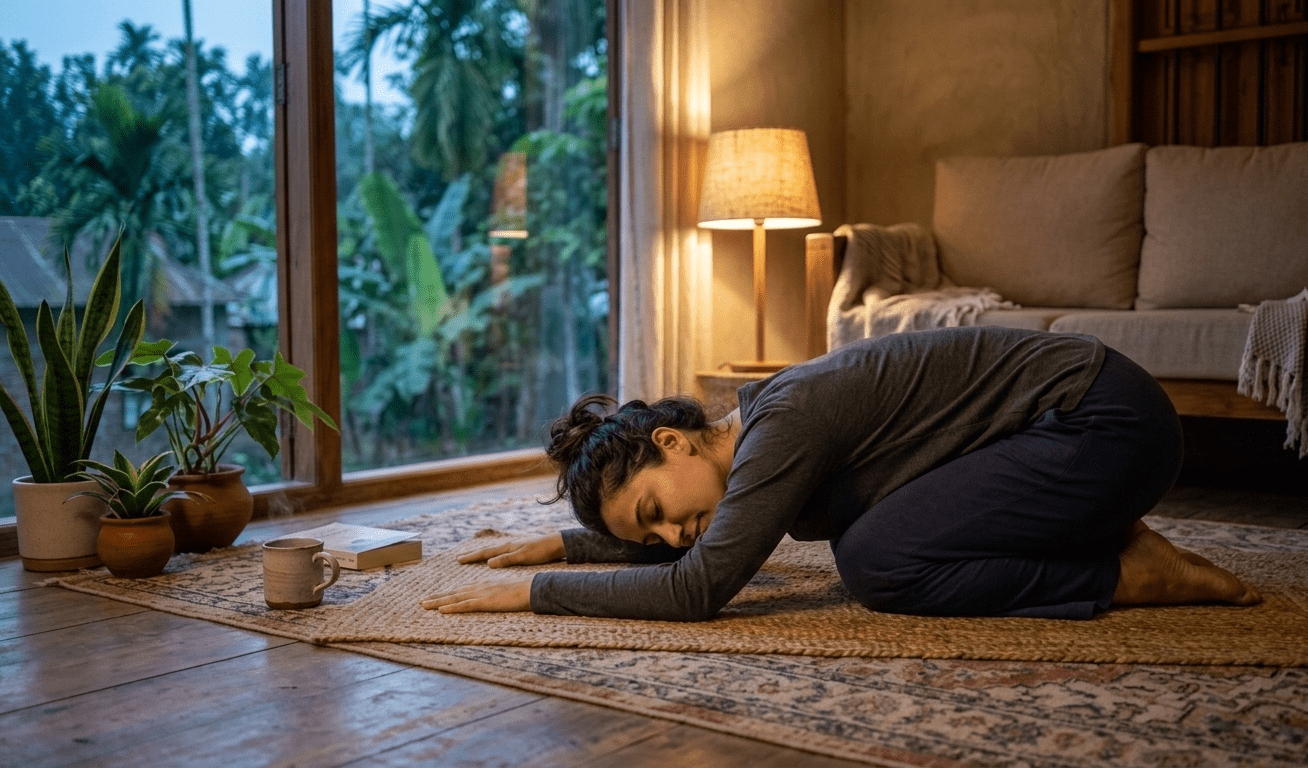
Child’s Pose is your reset button. Any time a pose feels overwhelming, any time you need rest, any time you want to reconnect with your breath — you come back here. It is a resting pose, not a passive one, and it is absolutely essential for beginners.
Start on hands and knees, then sink your hips back toward your heels, extending your arms forward with your forehead resting on the floor. Breathe deeply into your back, feeling your ribcage expand with each inhale. Hold for anywhere from thirty seconds to two minutes.
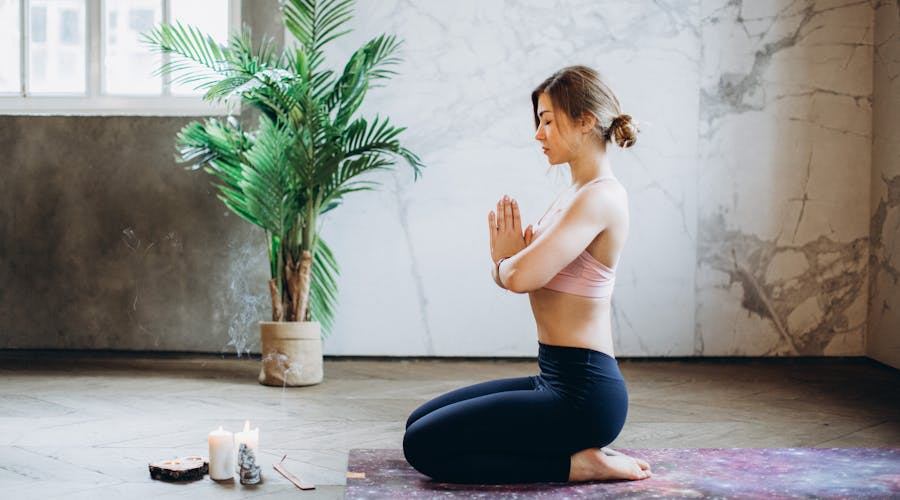
Child’s Pose gently decompresses the lower spine, stretches the hips and thighs, and activates the parasympathetic nervous system — the rest-and-digest mode that counteracts the chronic stress response most of us carry daily. If you do nothing else today, a few minutes in Child’s Pose genuinely helps.
3. Adho Mukha Svanasana (Downward-Facing Dog)
Downward-Facing Dog is probably the most recognized yoga pose in the world, and for good reason. It is a full-body stretch that works the hamstrings, calves, spine, shoulders, and arms simultaneously, while also gently inverting the body to improve circulation.
From hands and knees, tuck your toes and lift your hips up and back, forming an inverted V shape. Press your hands firmly into the mat, spread your fingers wide, and try to lengthen your spine. If your hamstrings are tight — and most beginners’ are — keep a slight bend in your knees. A flat back matters more than straight legs.
Hold for five breaths, pedaling your heels alternately if that feels good. With regular practice, this pose transitions from effort to rest. Most experienced practitioners actually find it calming.
4. Virabhadrasana I (Warrior I)
Warrior I builds power, focus, and stability all at once. It engages your legs, opens your hip flexors, expands your chest, and demands genuine concentration to hold well — which is precisely what makes it so rewarding as a beginner practice.
From standing, step your right foot back about three to four feet, angling it out slightly. Bend your front knee to a 90-degree angle, keeping it directly over your ankle. Square your hips toward the front of your mat, then raise both arms overhead with palms facing each other. Gaze forward or slightly upward.
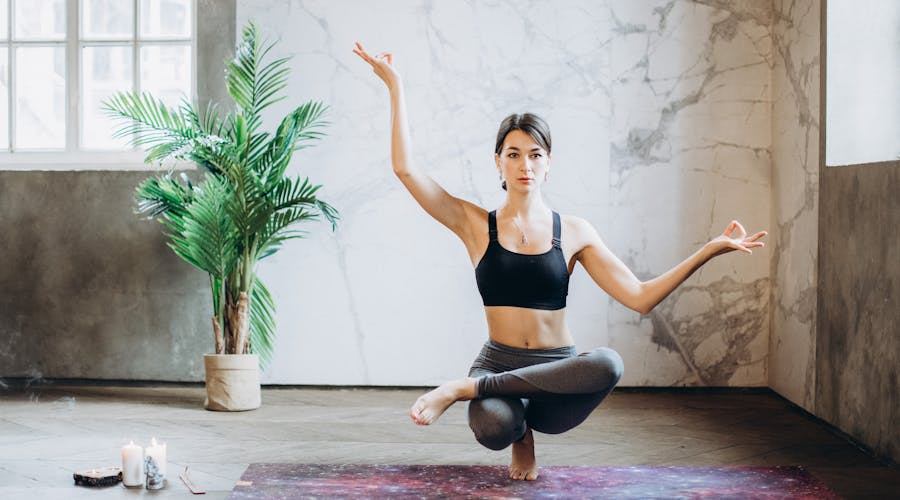
Warrior I teaches something important: discomfort and danger are not the same thing. Your legs will shake. Your hip flexors will protest. That is normal — that is growth. Hold for five breaths on each side and notice any tendency your mind has to check out when things get uncomfortable.
5. Virabhadrasana II (Warrior II)
Warrior II builds on the first Warrior but opens your body sideways, emphasizing hip opening and lateral strength. From Warrior I, open your hips and extend your arms wide — front arm reaching forward, back arm reaching behind. Your front knee stays bent, back leg straight. Gaze softly over your front fingertips.
The key is preventing your front knee from caving inward. Press it gently outward and keep your torso upright rather than leaning forward. Hold for five breaths per side. This pose develops endurance and patience in equal measure.
6. Vrikshasana (Tree Pose)
Tree Pose is your introduction to balance work in yoga, and it is humbling in the best possible way. Standing on one leg requires far more focus and full-body engagement than most people expect. Falling out of the pose — which you will do often at first — is a lesson in lightheartedness that carries beyond the mat.
From Mountain Pose, shift your weight onto your left foot and place the sole of your right foot against your inner calf or inner thigh — never directly against your knee. Bring your palms together at heart center, find a fixed point to focus your gaze on, and breathe. Hold for five breaths, then switch sides.
If balance is genuinely difficult, keep your lifted foot low or use a wall for light support. Balance improves faster than you expect with consistent practice — usually within a few weeks.
7. Setu Bandhasana (Bridge Pose)
Bridge Pose is a gentle backbend and hip opener that also strengthens the glutes and lower back. It is enormously beneficial if you spend long hours sitting, and the benefit-to-effort ratio feels almost unfair in your favor as a beginner.
Lie on your back with knees bent, feet flat on the floor hip-width apart. Press into your feet and lift your hips toward the ceiling, interlacing your fingers beneath your body if that feels comfortable. Hold for five breaths, pressing your shoulders and upper arms into the mat rather than pushing weight into your neck.
Bridge Pose also stimulates the thyroid, opens the chest, and has a measurable mood-lifting effect when practiced consistently. It is one of those poses that beginners love almost immediately.
8. Supta Baddha Konasana (Reclining Bound Angle Pose)
This is one of the most relaxing poses in yoga and works beautifully as a session closer or a wind-down before sleep. Lie on your back, bring the soles of your feet together, and let your knees fall open to the sides. Place your arms by your sides or on your belly and simply breathe.
The pose gently opens the inner thighs and groin while the supported reclining position triggers a deep relaxation response. If your inner thighs feel intense, place folded blankets or firm pillows under your knees for support. Stay for one to three minutes and notice how your body progressively releases tension.
9. Paschimottanasana (Seated Forward Bend)
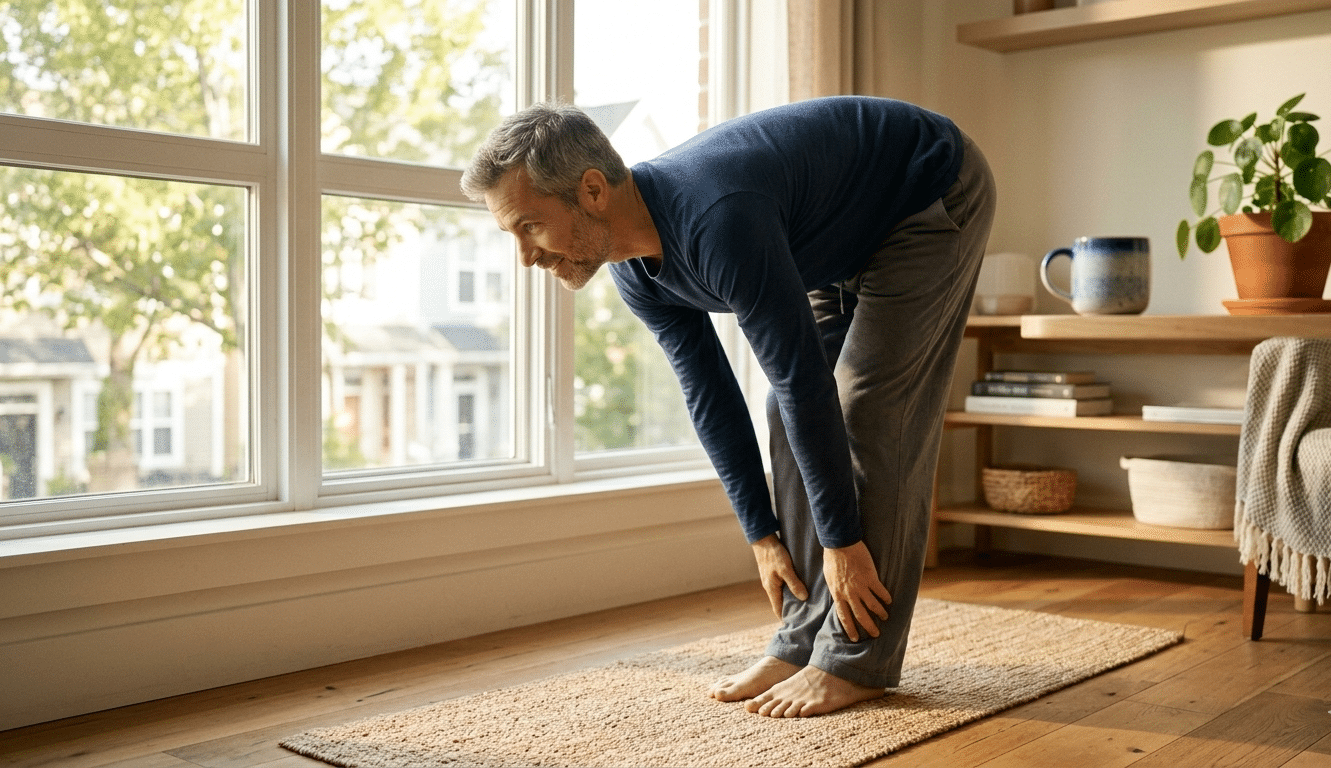
Seated Forward Bend frustrates many beginners because tight hamstrings mean you might only reach halfway down your shins. That is completely fine and exactly where you are supposed to be. The pose is not about touching your toes — it is about hinging forward from the hips with a long spine and breathing into the resistance.
Sit with your legs extended in front of you, flex your feet, and fold forward from your hips. Wherever your hands land — thighs, calves, ankles, or feet — is the right place. Hold for ten slow breaths. Each exhale will allow you to move slightly further forward. Never force it. The progress in this pose over two to three months of consistent practice is genuinely remarkable and motivating.
10. Savasana (Corpse Pose)
No yoga session is complete without Savasana. It looks like simply lying down — and it is — but it is considered one of the most important poses in the entire practice. After moving your body through a sequence, Savasana gives your nervous system time to absorb and integrate the practice before returning to everyday activity.
Lie flat on your back, arms slightly away from your body, palms facing up, eyes closed. Let your feet fall naturally outward. Consciously relax every part of your body from feet upward. Stay for at least five minutes — ten is ideal. When your mind wanders, which it will, gently return your attention to your breath without judgment or frustration.
The ability to consciously relax on demand is one of the most valuable skills you can develop for long-term health, and Savasana is how you practice it.
Building a Beginner Practice That Actually Sticks
The biggest mistake beginners make is doing too much too soon. Three sessions of twenty to thirty minutes per week is a highly effective starting point that most people can sustain. Pick four or five of the poses above, hold each for five to ten breaths, and end every session with Savasana. That is a complete, effective practice.
Consistency beats intensity every single time, especially in the early months. A twenty-minute session three times per week produces far greater results than a ninety-minute session done once. Your body adapts during the rest periods between sessions, not during the sessions themselves.
Give it six weeks before forming any conclusions. Most beginners notice meaningful improvements in sleep quality, stress levels, and physical flexibility within four to eight weeks of regular practice. The key is simply showing up consistently, especially on the days when motivation is low.
Yoga does not require a perfect body, a dedicated studio, or prior experience. It requires consistency, curiosity, and a willingness to meet yourself exactly where you are right now. That, more than any specific pose, is the real practice.
Are you just starting your yoga journey? Drop a comment below and let us know which pose you are trying first. We read every message and would love to cheer you on.